
Building Physical RSI Beyond the Known World
Intelligence is not about optimizing within a closed world—it is about transforming every surprise into the surge of its next evolution.
In March 2026, Andrej Karpathy released AutoResearch[1], a deliberately minimal system for autonomous AI research—and a useful illustration of the logic behind recursive self-improvement, or RSI: the idea that an intelligent system can improve the machinery that produces its next improvement. An agent edits training code, runs a fixed experiment, keeps changes that improve validation, and repeats. Each successful iteration creates a stronger starting point for the next, allowing progress to compound.
AutoResearch makes the basic loop especially clear:propose → experiment → evaluate → retain → repeat,and shows the promise of this loop to self-improve an AI system's own components.
However, this is evolution inside a closed, rule-based software sandbox: the environment is fixed, its relevant states and actions are bounded, and its objectives are defined in advance. The agent discovers what works, but not what world it is operating in.
Physical reality breaks this assumption: its rules have never been fully written down, its conditions keep evolving, its state is only partially revealed through multiple modalities, and its interactions cannot be fully enumerated. A household robot cannot be given a complete rules file for every object, person, and contact it may encounter. A factory controller cannot assume that its digital twin still captures a machine as its components wear and operating conditions change. An autonomous laboratory may encounter results that its current hypotheses cannot explain[2]. Self-improvement in such a physical world will inevitably encounter unexpected outcomes arising from limitations in the actor, the world model[3], or both.
Physical RSI must therefore improve both the actor and the world model, with each advance revealing the next frontier for the other.
Mirroring reality into a world model
The hardest problem in Physical RSI is not the actor, but the environment. The actor is the familiar part of RSI: propose, act, observe, update, repeat. In a closed digital domain, the environment can be specified as static code, tests, and metrics. Reality cannot be specified this way: it is too large to enumerate, too dynamic to freeze, and too costly to replay on demand.
To make reality available to recursive improvement, we need to mirror it into an evolving computational representation: an agentic world model. “Mirror” does not mean a pixel-perfect copy. It means translating multimodal experience into language-level abstractions of entities, states, relations, and causal dynamics. The model then generalizes through such abstractions that remain invariant across changes in appearance[4].
Language and code make this mirror both generalizable and revisable. Language allows it to draw on scientific and everyday knowledge from pretrained models, while code turns that knowledge into explicit state variables and executable dynamics. A coding-based agentic world model can thus turn a surprising episode into a simulator and reusable rules that transfer across rooms, cable colors, robot bodies, or superficially different scientific systems. Its abstractions may be wrong, but they can be explicitly verified, revised, and improved.
OOD is the engine of Physical RSI
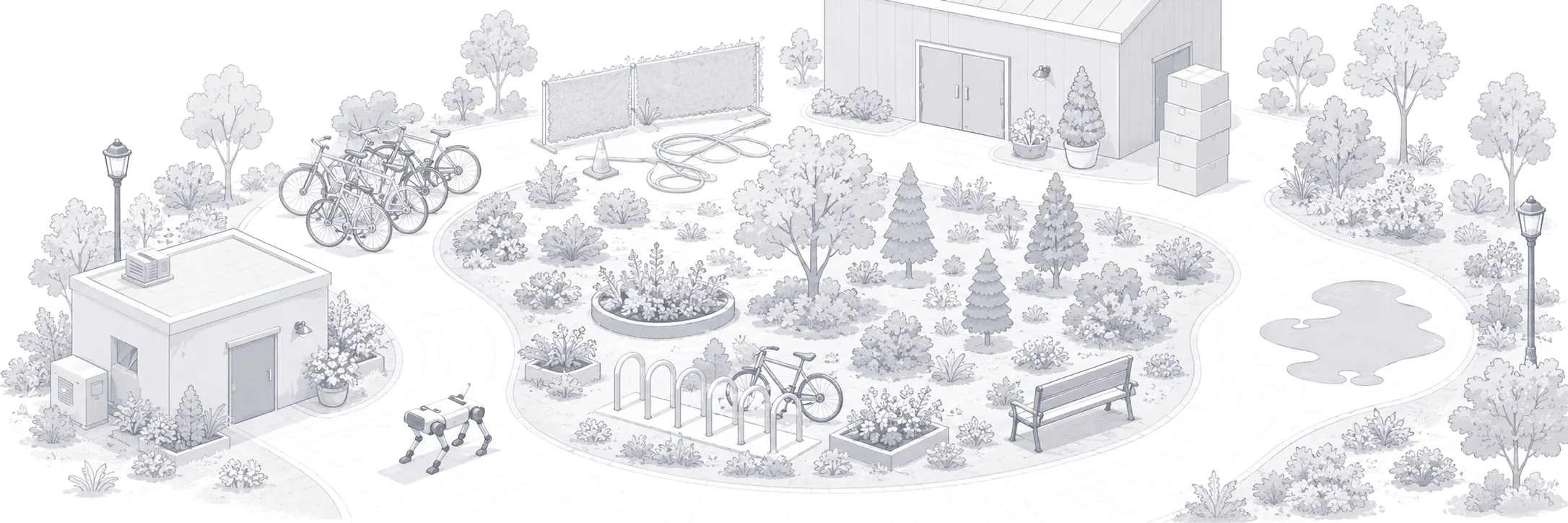
In an open world, an OOD event is a routing signal that reveals where the system has reached its limits—and what must evolve next. We call such an event a surprise. Consider a robot dog whose leg becomes tangled in a cable. Choosing a recovery action requires reasoning about what happened in the world: can the world agent reproduce how the cable path, contact, tension, and leg motion produced the failure? If it cannot, the system has an environment gap. The world agent must abstract the missing dynamics and turn the surprise into a reproducible family of environments. Once the failure can be reproduced, the remaining question is whether the actor can solve it. If not, the system has a skill gap. The actor then enters its own RSI loop, searching for and refining a recovery strategy within the expanded environment[5].
Both the revised world model and the new strategy must be verified in reality. If verification fails, the discrepancy becomes new evidence for further diagnosis and improvement. If it succeeds, the system internalizes a better world model and a new behavior.
The evolution loop becomes:encounter → surprise → diagnose → abstract → simulate → solve → verify → internalize
Just as an agentic LLM system can improve itself by generating and validating training code, data, and algorithms that produce its next improvement, Physical RSI emerges when an agent can autonomously discover and resolve OOD events. Each surprise becomes a complete learning experience grounded in its own accumulated physical knowledge: identifying what failed, revising the world model, searching for a response, verifying it in reality, and finally consolidating the new knowledge. Scaling these experiences creates the recursive substrate for accelerating improvements of both the actor and the world model[6].
A research roadmap for Physical RSI
Key components of Physical RSI require progress on several underdeveloped capabilities, providing a clear roadmap.
- Environment understanding and abstraction: The system grounds multimodal observations into structured and executable representations (code, language, etc) to capture relevant entities, relations, and dynamics. This capability supports the diagnose → abstract stages of the loop.
- Agentic physical reasoning: The system should orchestrate diverse sources of knowledge and simulation capabilities to transform physical reasoning into a compositional, verifiable, and iterative process. This corresponds to the simulate → solve → verify stages.
- Continual learning from experience: Each verified abstraction and solution should be consolidated into durable world knowledge, reusable skills, and regression tests. These capabilities must generalize beyond the original case while remaining adaptable to new evidence. This is the internalize stage.
- Discovering the unknown: The system can actively probe the boundaries of its knowledge by identifying uncertainties and designing informative experiments. Making the discovery of unknowns an intrinsic objective drives the encounter → surprise stages and closes the loop.
This roadmap also requires next-generation evaluation and interpretability[7]. Evaluation does not target performance on a fixed benchmark, but how reliably, efficiently, and autonomously a system turns unknowns into verified and reusable capabilities; and mechanistic interpretability becomes a scientific instrument for understanding, monitoring, and guiding the internal process of self-improving intelligence.
From local solutions to general intelligence
 HouseholdRobotics
 Fabrication
 ScientificExperiment
 FieldExploration
Physical RSI becomes especially valuable wherever every action is an experiment on a world that is only partially modeled. Across robotics[8], advanced manufacturing, and autonomous scientific experimentation, the loop is the same: act in reality, discover what the model missed, and make the next action from a larger world.
At first, progress appears task-specific: recover the robot, correct the print, improve the protein. But recursion changes the object of improvement. The system no longer merely solves problems within a fixed world; it expands the world in which solutions can be found. Failures become structure, surprises become models, and previously intractable situations become actionable.
General intelligence is therefore more than better optimization over a given problem space. It is the capacity to expand that space—transforming every encounter with the unknown into the genesis of its next evolution.
Further reading
- 01Andrej Karpathy, AutoResearch, 2026. ↗
- 02An Autonomous Laboratory for the Solid-State Synthesis of Inorganic Materials, Nature, 2023. ↗
- 03David Ha and Jürgen Schmidhuber, World Models, 2018. ↗
- 04Yann LeCun, A Path Towards Autonomous Machine Intelligence, 2022. ↗
- 05World Labs, Building Worlds That Train Robots, 2026. ↗
- 06David Silver & Richard Sutton, Welcome to the Era of Experience, 2025. ↗
- 07Joseph et al., Interpreting Physics in Video World Models, 2026. ↗
- 08Physical Intelligence, π₀.₅: A VLA with Open-World Generalization, 2025. ↗
BibTeX
@misc{mirros2026physicalrsi,
    title  = {Building Physical RSI Beyond the Known World},
    author = {{MirroS Team}},
    year   = {2026},
    month  = {Aug},
    url    = {https://mirros.ai/blog/building-physical-rsi-beyond-the-known-world},
    note   = {Blog post}
}